Saturday, September 4, 2010

Geology 101


When you are driving 450-500 miles a day, you tend to fill in the hours with observations of the surounding environments and probably reading the information at the rest stops as they come along. That's where the mesa/butte/plateau debate started (scroll down to the beginning of these posts if you haven't read that scintillating discussion!)


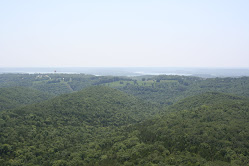
So here's a few more additions to my new book, "Geologic formations observed driving from NJ to Alaska and back." Pictured to the left is a rock formation called a "Tor" (or a "High Tor" if you are Maxwell Anderson) (private joke to the dramaturgs among us). This is a volcanic formation, in this case above the Arctic Circle but visible elsewhere, where erosion has left dramatic rocks sticking up from the surrounding surface. They look really cool when they are completely surrounded by tundra or, in the plains states, grassy meadows.


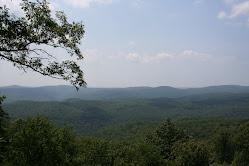
The second picture is tundra, again above the Arctic Circle, and showing signs of impending autumn in the only way it can, since there are no trees. Tundra is an area of permafrost (i.e. permanent frost) so close to the surface that tree roots cannot take hold, so only shrubs, grasses, and sedges can grow.


A third formation, not pictured, was one I was totally unfamiliar with until we reached the rolling hills of Montana. I now understand why that state has the Spanish name for "mountain": it must have been extremely difficult for Lewis & Clark and future emigrants to cross this irregular terrain. I also maybe understand why they stopped their westward ho when, after going up and down these rolling hills, they saw the snowcapped peaks of the Rockies a few miles ahead. "Hey Ma, you know I was just thinking, we could probably settle right here, raise a few cattle or sheep - whaddaya think?"


OK, enough with the "rolling hills". Their proper names are Laccolith Domes: a rounded raised area, usually treeless, of about 50-100 feet in height. It's a Butte. When some of the rocks have been eroded, to reveal a ring of rocks about 1/3 of the way down the dome, it's known as a "Belted Butte".


Amazing what you learn when crossing this butte-T-full country. (Sorry, I could not resist.)

More wildlife


Couldn't forget these two sightings: Bald eagle flying overhead in Whitehorse, Yukon (after a few views in Alaska as well) and this close up of Mama Grizzly either teaching the cub how to fish or trying to keep it to herself, just outside of Haines, Alaska.
Amazing.
(If you haven't read the other posts about wildlife, continue below...)
Friday, September 3, 2010

Wild Life


Driving down the last few miles of the Alaska Highway, we were warned of various wildlife crossings ahead. Having seen these earlier on the trip, but no animals, we didn't reallly expect too much. But British Columbia was like Yellowstone for free. One of the unique signs was a picture of a bison. A woods bison, as opposed to the prairie bison one sees in North Dakota. And sure enough, there they were. They were not crossing the highway, but a large herd assembled at the side of the highway - bulls, cows, and a few calves; some just lazying in the sun, others at serious work nibbling the grass. A few miles later, at Muncho Lake, the terminal range of the Rockies (did you know the Rocky Mountains ended in British Columbia? Neither did I - somehow, I thought they just went up the spine of North America into the Arctic), a few Stone Sheep walked along the highway, licking the salts that remain on the roads from rain or winter plows. In addition, a little further down the mountain road, a single caribou glanced our way from roadside, but continued nibbling the grasses and sedges there. And then, finally, as we drove away from Fort Nelson, a black bear nosed its way out onto the highway, looking both ways and then, as we drove past him, ran across the road to berries or plant roots that always look better on the other side.
But no moose. Yet.

Friday, August 27, 2010

A real trip to an imaginary circle


North of Fairbanks, Alaska, the Dalton Highway stre4tches upwards to Prudhoe Bay, the beginning of the Alyeska, otherwise known as the Trans-Alaska Pipeline. We wouldn't get that far, but we planned to get a little north of the Arctic Circle, the imaginary line that separates the polar zone from the rest of the world.

The Dalton Highway - Alaska State Highway #11 - is largely unpaved. It's occasionally rocky, occasionally muddy, and occasionally actually paved or in the process of being paved. At one section, the by-now-familiar pilot car took us through one lane traffic. To reduce dust for the workers, a tanker sprays water on the road at various intervals. While not slippery, it does produce a fine mud mist, especially if you allow yourself to get a little too close to the vehicle in front of you, some of which were large oil tankers on their way to the Arctic. By the time we emerged onto "solid" road, my beautiful burgundy car was two-toned, with the bottom half a lovely mottled tan.

But before we knew it, we were at the Yukon River Bridge. We'd had fun following the Pipeline, as it sometimes got extremely close to the roadway and then disappear into the spruce trees. On hills, we could see the brown-gray road and the silver pipe ahead. In some spots, the pipeline went underground, under the road, and even under rivers. At the Yukon, it joined our bridge and stretched over the mighty river. At the other side, a Visitor Center welcomed us, for which we had to drive under the pipeline!

A few miles further took us to the strange land of Finger Mountain. Large piles of volcanic granite made formations - one like a 40-foot high pointer finger beckoning "come here" to those who drive up themountainside. Few trees grew on the tundra that surrounded the mountain. Small shrubs and blueberry bushes decorated the ground, some of them turning yellow and red in the sub-arctic autumn that was fast approaching. The story goes that the Fireweed plant keeps blooming to the top as the season progresses. When the tip-top blooms, winter is just around the corner. Many of the roadside plants were flowerless and it's "only" August.

And finally we reached the Arctic Circle. No, there's no line on the road at latitude 66 degrees, 33 minutes. But there is large plaque that proclaims we made it - a probable once in a lifetime crossing (well, 3 times actually, as we had to go back a few miles for our sleeping arrangements...and we had to come back this way!) It was kind of cool (literally and figuratively). We had set a goal and achieved it. No flat tires, no broken windows (yes, OK, a few scratches under that muddy exterior). But we'd reached it - "top of the world, Ma!" Now onto Coldfoot and Wiseman, the two towns above the circle that would provide us food and shelter for the next two days.
Friday, August 20, 2010

North to Alaska


The way to travel...Ferry from Washington state to Haines, Alaska. From there, drive the Haines Highway through part of British Columbia into the Yukon Territory.. (Pictured: our ferry M/V Columbia leaving port after dropping us off in Haines and a very welcoming sign.)
And onto the Alaska Highway. Built in 1942 to help get our troop equipment to Alaska to fight in the Aleutian Islands (Japan had landed on Attu), it has been rebuilt several times since (and they are still rebuilding parts of it - about 20 miles of it is dirt which we travel following a "pilot" vehicle to guide us safely through construction.). It runs from Dawson Creek in British Columbia to Fairbanks, Alaska. We're only doing a section of it on the way up, but we will drive the entire highway heading home.


Welcome to Alaska.


Monday, August 16, 2010

A Northwest Passage


Wow - we're back on land and online!
Leaving San Francisco, we crossed the Golden Gate Bridge and left it and its fog behind to enjoy the fog of the Oregon coast, which burned off by noon most days to allow us a clear view of a rose garden in Eugene, cheering on the Eugene Emeralds in an A team baseball game (they won 3-1), stopping at a lighthouse or two and the fabulous Columbia River Maritime Museum in Astoria.
Up I-5 to beautiful Bellingham, Washington to catch the ferry on the Alaska Marine Highway. With no WiFi on water, we relaxed watching the Canadian coastal mountains and its many islands float by us.
We listened and learned about northwest flora and fauna from a naturalist (a Forest Ranger from Tongass National Forest); we saw a few seals frolicking, "ooohed" at a humpback whale breeching a few hundred yards from the boat, and then, as we arrived in Haines, Alaska, we were treated to a mama brown bear teaching her two cubs how to catch salmon. What a great way to travel!

Saturday, August 7, 2010

Leaving one's heart in San Francisco

OK, so I should have planned an extra week beyond the conference in this fabulous "city by the bay". In addition to workshops on improvisation and theatre games, we managed to explore a little portion of Golden Gate Park (the Japanese Gardens and the Dahlia garden), bypassing the fairly expensive deYoung Museum, even though I would love to have seen the Impressionist exhibit; the Embarcadero (featuring a fabulous performance of "Peter Pan" combining live performance, puppetry, and CGI); Fisherman's Wharf and a sunset cruise that could not quite find the sun setting, but enjoyable nevertheless as we sailed past Alcatraz and under the fog-bound Golden Gate Bridge; and some shopping in Macy's, Bloomingdale's, and Nordstrom's. We finished up with a hike through The Presidio (a National Park at the base of the Golden Gate), stopping to visit the Disney Family Museum, an intensive exploration of the life, films, TV shows, and entertainment parks of Walt Disney which suggests it'll take 1 and 1/2 hours to explore, but you really need 2 days.
And tomorrow we head north, thinking that we do indeed need to come back, because a heart is a terrible thing to lose.

Wednesday, August 4, 2010

land formations

When one is driving across the USA, one pays attention to the divergent landscape. After the Great Plains of Iowa and parts of Nebraska and Wyoming, mountains are quite interesting. Of course, there's the patches of snow on the peaks above 10,000 feet, but along I-80, some of the most interesting formations are raised platforms of rock and sand. I have learned that the largest of these is a plateau - an area that is above the adjacent terrain on at least one side; similar is the mesa - from the Spanish for "table", it too is a flat raised area, but it is toyally surounded by lower terrain. Finally, the smallest of these is a butte - which one dictinary says is an "eroded mesa". but can be seen as a smaller version. Completely eroded buttes often result in hoodoos - tall spire like formations. Descending from the mountains into the basin of Utah, one encounters the salt flats - a flat section of land that is covered with salt from evaporated water (aren't you glad you asked?) We drove passed the most famous of these - the Bonneville Salt Flats, a section of which is used to speed test cars. The speed limit on the highway near there is 75 mph, although most folks go a bit faster. A favorite practice of the locals is to take dark rocks and stones arrranged on the white salt to make formations like hearts (better than carving on a beech tree I think) or initials or messages like "peace" or "Go Vikings" (I don't think they mean the ancient Danes, probably a local sports team).

Monday, August 2, 2010

Rocky Mountain High

We're in Utah, about 40miles from Park City (home of the Olympics), surrounded by the grassy sagebrush hills of the Rocky Mountains. We're staying in a lovely little cabin (emphasis on the little) near a stream in the quaint town of Coalsville. After dinner, we took a stroll up a country road and saw some wildlife: an osprey on his nest (didn't know they liked streams), a goldfinch (had to come to Utah to see the NJ state bird), a rainbow from a distant storm, and now, as I finish this outdoors on the picnic table, thunder and lightning from that not-so-distant storm!

Sunday, August 1, 2010

Shy Anne

We covered the entire state of Nebraska today. We made good time, traveling through its capital (Lincoln) and following the various Platte Rivers as we drove. Lunch was a Sunday Buffet at "Grandpa's" in Kearney, NE (pronounced just like the one in NJ). Very popular spot for locals, but I think we were among the youngest in the room. Nevertheless, they gave us the "senior discount" without being asked. Damn - I didn't think we looked old enough. But "all you can eat" for $10 each? I'll take the deal.
We also took a get-out-and-stretch break in Ogallala, where we found the "Mansion on the Hill" open for tours. We'd been by this home years ago on a previous trip while visiting nearby Boot Hill cemetary, but it was closed. So we took an hour to explore this brick home built in the 1870s, filled with interesting items from those years and on into the early 20th century, when the nearby river was dammed, creating a reservoir. With the time change (we're now in Rocky Mountain time, even though those peaks are not yet in evidence), we made up the visit, went way past our intended destination in Nebraska, and made it about 60 miles into Wyoming to stop for the night in Cheyenne. No camping though - it's raining and we need showers after the 90 degree temps down on the plains.

Saturday, July 31, 2010

Our Stake in Omaha


We are finally "camping" - in a KOA, sleeping in the van, and heating up some leftovers on our new Bass Pro stove. We're just outside Omaha, Nebraska in the town of Gretna. It's a little buggy - gnats and flies don't totally understand how the new "Off fan" works. But I'm sitting at our picnic table, listening to the locusts buzzing in the trees and watching the sun go down, a little after 8 p.m. CST, across the cornfields. We had a great drive from Illinois, 415 miles on I-80. We crossed the mighty Mississippi (running high; they had floods in Iowa last week) and saw fields of wind turbines - about 30 in a row, stretching across the cornfields and rolling hills of Iowa. (Interesting place, Iowa. Is it "State Fair" that says "You really ought to give Iowa a try"? We have in the past - the bridges of Madison County, the Danish themed town of Elkhorn, - but we could come back for a cluster of German villages from the 1850s called Amana Colonies and, of course, there's Des Moines and Council Bluffs. It really is amazing what is out here - or anywhere for that matter - for us to see and explore.)

But no time. San Francisco beckons in 3 days. And Nebraska is more than 450 miles long!

Friday, July 30, 2010

Continuing a theme...

Well, we missed Utica (see last night's post) because of a diversion of traffic on I-80 just west of Chicago. But, in a continuing theme of last night's entry, we traveled "alternate I-80" through Newark, Lisbon, Norway, Peru, and Marseilles, all within the space of 30 minutes and geographically in Illinois. Talk about "alternate". We ended up staying the night in Ottawa - no, still in Illinois. But we got talking with a couple in the parking lot (small dog in their arms, a ball of yarn in Patty's: natural elements for a conversation to start up) who were actually from Ottawa, Canada! They're heading for Vancouver Island and decided it might be fun to visit a namesake town. Forecasts of heavy T-storms made us pass up on our planned encampment at Starved Rock State Park and settle on Holiday Inn instead. We'll watch for a camp tomorrow, somewhere in Nebraska.

Thursday, July 29, 2010

On the road again...

It's 2010 and I'm going to try to keep this blog up to date with an occasional entry as we travel west to San Francisco and then North to Alaska once again. Our first day took us through several major back-ups thanks to closed lanes on I-80 in PA, but we arrived safely if late. As we drove along, I was thinking about the places that replicate other place names across the USA. I mean, here I am in Boston Heights, Ohio! Not a hill overlooking the Massachusetts city. Not too far from here is Miami (OH) and on the way out, we passed by the Jersey Shore in Pennsylvania. (I've heard that a group from NJ settled on the banks of a nearby river and the natives of the area began to call that bank of the river "the Jersey shore".) And we also passed nearby Indiana, Pennsylvania - those folks just can't decide where they are!
Of course, there's only one Rahway.
Tomorrow, it's off to Utica...Illinois.

Sunday, September 6, 2009

History in a Weekend

Heading the opposite direction from our summer travels, we concluded the summer of 09 with a trip north and into the past. Massachusetts, being one of the oldest settlements in the "New World", has a fascinating and involving history, both political and literary. We settled on a long weekend in Sudbury, about 20 miles west of Boston, largely because we got a great offer through Travel Zoo. (If you don't know that site, check out http://www.travelzoo.com/ - we have enjoyed our various stays through its services.)
Anyway, Sudbury is home to the Wayside Inn, as in Henry Wadsworth Longfellow's "Tales of a Wayside Inn", reclaimed from history by none other than Henry Ford, who used it as a summer home. It is now a restaurant and a BnB, and its grounds feature the removed-from-its-original site-and-reconstructed Red Brick Schoolhouse which reportedly is the school attended by Mary of little lamb fame. It also has a rebuilt gristmill, still used - the flour, cornmeal, and bran ground there is used by the restaurant for its delicious breads served wth meals. (The gristmill is also the site of the plastic "duck race" on Labor Day to raise funds for a children's hospital. We have a "six quack" of entries - their words, not mine - so wish us or them luck. The ducks are released upstream of the mill and then careen down a waterfall and stop a few yards down stream.)
A few miles north of Sudbury is Concord, of grapes and revolutionary war fame. We spent a while walking over the "Minuteman Bridge" (which Ralph Waldo Emerson called the "shot heard round the world"), and pacing the old Boston Post Road which begins the "battle road" of April, 1775. We also visited the Emerson home known as the Old Manse, which was owned by the Emerson family and borders the Concord battlefield. Years after, it was the temporary home of Nathanial Hawthorne, who authored "Mosses from the Old Manse" there which contained his early short stories like "Young Goodman Brown". (He also wrote graffitti on the windows by etching the glass with his wife's diamind ring. The words are still there.) And, of course, you can't spend too much time in Concord without mentioing Henry David Thoreau - a main shopping street in town is named for him; he was a good friend of Hawthorne; his Walden Pond cabin is a few miles south of town; and he, Hawthorne, and Emerson are all buried on "Author's Ridge" in the nearby Sleepy Hollow Cemetary. Down the road a piece is Lexington where the battle continued and essentially began the Revolution.
Another short - well, about 50 minutes - trip southwest of Boston is Quincy, home to the birthplace and residences of John and Abigail Adams and John Quincy Adams, the first father-son presidents (we won't be visiting the homes of the second). They are also buried nearby, in a crypt under a Unitarian church that John Adams helped raise funds to build. Fact I did not know (or at least remember): John Q. Adams is the only president to return to Congress after his presiency, serving 17 years in the House of Representatives, where he literally died while giving a speech one day at the age of 81. It was a slight thrill to stand on the same porch that John Adams did and walk down the "President's Hall, used by John Quincy, when he stayed in his "summer white house" there.
Some great natural areas abound as well - Boston has "Blue Hills Reservation", a huge public park that borders Quincy and Milton, with some fabulous trails through the woods and up to a few hills (only 500 feet above sea level, so not a lot like West Virginia) but with an astounding view of Boston and its harbor. Nice trek through piney woods.
An instant return to the 21st century as we drove onto I-93 and I-95 at 65 miles per hour back to our lovely little Carriage House Inn in Sudbury.

Tuesday, August 18, 2009

"Shanandoah..."

Go ahead, I dare you to not have that song in your head as you read this.
West Virginia was lovely and we celebrated our departure, and our anniversary, by hiking up to the top of the Seneca Rocks, 1000 feet from the valley floor, about three miles round trip. And then it was down the mountains into Virginia and a relaxing BnB in Staunton (pronounced as if the 'u" wasn't there). Staunton is home to the American Shakespeare Company, performing in a replica of the Blackfriars Theatre, Shakespeare's indoor theatre in London. The small company performed a rousing production of "The Merry Wives of Windsor", one of the comedies that I have not seen. Very funny - almost the invention of sitcoms, with trickery, puns, and jokes, including a "stand-up" dialog where a teacher and a student dscover that some Latin declensions sound absolutely vulgar in English. "Horum est" indeed!
Staunton is also close to the southern end of Shanandoah National Park and its Skyline Drive. Choosing to enter the park 1/3 of the way up the drive, we discovered that Sundays are "no fee" days. We also discovered that, contrary to the website, the lodges on the drive had rooms available. So we were able to get a fabulous room at Skylands, overlooking the western side of the mountain. Which enabled us to explore a little more of the park: Dark Hollow Falls, a short but steep walk of about 1.5 miles round trip. It was tough to ignore the little voice in the back of our heads whispering, as we descended toward the falls, "you have to walk this back up...you have to walk this back UP..." But we made it. Enough to allow us to walk up (you get to walk down after!) to Stony Man Point, another mile or so to a rugged cliff, supposedly on the "forehead" of a face-like outcropping, just in time to watch the sun set into the mists over the western Appalachians. Walking back in the dusk, a few deer and their fawns took a moment out of their evening meal to watch us go by. We returned to Skylands and sat on the porch once again, watching as the stars above and streetlights far below began to twinkle on.

Tuesday, August 11, 2009

"Country Roads....West Virginia!"

We flipped a coin from Harrisburg...north or south. I think maybe we saw an ad for West Virginia or something, because south won. And we are glad it did. A cyber-search led us to a little "town" (unincorporated) called "Cabins". Probably because there are about 100 cabins and cottages to rent. We chose Harmon's North Fork cabins, located along the Potomac River (the north fork of it, clever name, no?). The cabins are about 15 years old or less and are literally located along the river. Each cabin has a jacuzzi in the bedroom, air-conditioning (needed these 85-95 degree days), and a full kitchen. Front porch with a view of the river and a swing. Comfortable. Gorgeous. And not right on top of the neighboring cabins (some of which have hot tubs if you want to pay a little extra).
In addition, there are a lot of things to see if you get bored sitting on that porch or wading/swimming in the Potomac. (So Washington threw a dllar across the Potomac? We swam across! Well, walked. It's a fairly narrow and shallow river out this way.) Hike up a trail to a 900 foot high outcropping of sandstone to see the river and surrounding farmlands. Drive an 8 mile road up to "Dolly Sod", an Allegheny plateau, 3500 feet above sea level, where another 8-mile road takes you along the top of the world. Stop and walk through Bear Rocks where bare rocks mark a path through blueberries, mountain laurel, and scappy "one-sided" pines holding on for dear life against the wind and the rocky soil. Drive the 16 mile road through Smoke Hole canyon. Seneca Rocks. Seneca Cave, the largest in WV. Spruce Knob, the highest point(4800 feet). Or just relax in the jacuzzi with a bottle of local wine, cheese, and fruit after a fun day of driving, hiking, or sightseeing. Sound like a commercial? Sorry. It's just a great place to spend a few days and one to which we would return.

Friday, August 7, 2009

Baseball, slots, and flat tires

Lots of things to keep one busy in Harrisburg. Thursday night, after dinner, we took a stroll to City Island, down a few blocks from the hotel and across the steel Walnut Street bridge, closed to vehicular traffic since 1972. A sign announced a ballgame tonight! Harrisburg has an AA team affiliated with the Washington Nationals called, appropriately enough, the Senators. So we bought a reserved seat for $8 and went on to "root, root, root for the home team". But, like their namesake senators, they just couldn't get it together. We left after the 7th inning stretch with the score at 5-1, in favor of the Binghamtown Mets, affiliated with...well, you can figure it out.
And then there's the car. After getting some articles from our car, the valet staff discovered that one of my tires was almost flat. By the time they reached me, it was completely flat. So the valet (Russ) and I (and another employee who was on his day off but passing by) took off the spare and changed the tire - the first time I've had to do that with the Honda in nearly 8 years. Then off to Firestone to get it fixed. Nope, can't fix it, slow leak, need a brand new one. Oh well, maybe I'll get to the Capitol tomorrow. But while they were fixing, I took a nice walk in the sunshine along the Susquehanna, learning the history of the town through roadside markers (it's their "Susquecentennial" - that's what they're calling it - 150 years since John Harris established the town) and getting some exercise - a little more than a mile round trip from Firestone.
And a side note to our travel: on the way to Harrisburg along I-78, we stopped for a brief sojourn in Bethlehem, PA, and the new Sands casino, built to resemble an old steel plant. We dropped their welcome package pretty quickly, even though it was penny slots, but I managed to make back my own investment (plus $15) with the "Hee-Haw" slots. Of course, then I spent the winnings on lunch at the Irish pub. Oh well, at least it's closer than Atlantic City.

Thursday, August 6, 2009

What's there to do in Harrisburg??

Summer of 2009 was the first one in over 20 years that we did not go to the AATE convention. Patty decided that, after years of her traipsing arond towns while I went to theatre workshops, it was my turn to explore while she learned about dolls - specifically Madame Alexanders. So here we are in beautiful downtown Harrisburg, PA. Now a lot of people said to me "Harrisburg? What can you do in Harrisburg?" But our philosophy is "no matter where you go, there you are..." so there must be something! It is the state capital, after all.
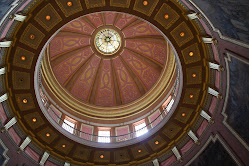
And, true to form, there are a number of things unique to Harrisburg - not the least of which is its Capitol - one of the few that does not have a gold dome, but rather a multicolored mosaic. And the Pennsylvania State Museum, just down the street, is also quite interesting in its presentation of natural and cultural history of the state. Do you know the difference between a pond and a lake? A lake, through succession, becomes a pond when it is smaller and shallower, though it did not specify a particular depth. A hill, on the other hand, becomes a mountain when it is over 1000 feet tall. Some fabulous displays on animal life in PA and one of the nicest collections of transportation vehicles since the Ford Museum in Michigan.
And still to come: City Island, in the middle of the Susquehanna River; the Harris Mansion (founder of the town) and seeing "Harry Potter" in IMAX.
And you thought there was nothing to do in Harrisburg.

Monday, May 4, 2009

One of the best concerts ever

Happy Birthday, Pete Seeger. For those too young to know him, you probably know his songs - "Turn, Turn, Turn", "Where Have All The Flowers Gone?", "Wimoweh", "We Shall Overcome" or his versions of others, especially those by Woody Guthrie like "This Land is your Land". He turns 90 this month and a few friends got together to pay tribute - with a few thousand fans in the audience. It was a fundraiser really for his Clearwater sloop, an educational ship that trolls the waters of the Hudson River urging environmental concerns. The packed Garden was happy to donate, myself included (thanks to friend and former clleague Jim Sauer). And what a lineup! I didn't recognize every name, but the fact that all of them felt touched in some way by his music, his activism, his life was astounding. After an brief appearance by Native American narrators, John Mellencamp led it off, followed by appearances by actor Tim Robbins (he sang later, too, with his son) and the NY Labor Chorus. One performer said he was glad we were singing under this president and not the former - several very liberal opinions were expressed, not the least of which was Billy Bragg singing part the "The Internationale". Ani DiFranco, Bruce Cockburn, Tom Paxton, Eric Wesberg, Dar Williams, Bernice and Toshi Regon, the blues man Taj Mahal, Steve Earle, Emmy Lou Harris, Kate and Anna MacGarrigle with their children, including Rufus Wainwright, Teddy Thompson, Joan Baez, Bela Fleck, a poetry reading by actress Ruby Dee, and the Preservation Hall Jazz Band, and that was just before intermission! Afterwards, we heard from TV producer Norman Lear, Tom Chapin with Oscar the Grouch (singing, appropriately "Garbage, Garbage" - Carol Spinney came out with Oscar later), Kris Kristofferson (who amazingly sang the old camp song "There's a Hole in the Bucket..." with Ani DiFranco), the Irish singer Tommy Sands, Richie Havens, Jay Ungar and Molly Mason (who will be in Chatham later this month), Arlo Guthrie, Del McCoury, John Hall (from the group Orleans), Ben Harper, Pete's sister Peggy who read from her journals, Rambling Jack Elliot, Roger McGuinn (of the Byrds), Dave Matthews, Bruce Springsteen (who did an amazing version of "The Ghost of Tom Joad" with Tom Morello, and, of course, Pete Seeger, whose voice was never the greatest and is showing his age, but his banjo picking and his enthusiastic gait strutting on and off stage several times sure didn't look 90. And I'm sure I missed a few.
Those who left after the finale of "This Land" missed Pete's grandson Tao Rodriguez-Seeger leading the entire cast and garden in "Bring 'Em Home" and "This Little Light of Mine", two others popularized by Pete. And he introduced us to the family - his older (!) brother John (95 - good genes in that family), Peggy, and his grandchildren.
I'm not a big fan of arena shows - but this show was filled by true fans of Pete and these artists - they were respectful of those they didn't know that well (very few catcalls of "Bruuuuce" at inappropriate times) and they were fanatic about those they did. And the artists were amazing too - no egos demanding more time or "headlining". It was truly one of the best concerts ever.

Sunday, May 3, 2009

Where does the time go?

Wow - I really thought retirement meant relaxing - nothing to do but read, write blogs. Hmm. I have certainly managed to keep busy. Some travel. In January, we went to Disney World and stayed at our "home" in Sarasota Springs Resort. I directed a production of Neil Simon's "Fools" that ran in March in Westfield. I helped build the set and hang the lights for Cranford's "Peter Pan" that opened May 1st. And did a little work around the house. And garden.
We've also seen several concerts and shows. We're new fans of Two River Theatre in Red Bank, watching their fabulous productions of "Mary's Wedding" and "Melissa Arctic". And we're getting set for new travels coming up in August. Hmm. Good thing I'm retired.