Tuesday, December 23, 2008

My retirement year - October


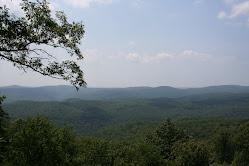
For the past 37 years, autumn meant "back to school". If we managed to see its famed foliage, it was a quick weekend trip to the Poconos, or High Point, or Sunrise Mountain's overlook at Stokes. But now, it occurred to us, that we could travel at this fabulous fall time of year. Though we had not yet closed on the house, we decided to try to relax a little by heading north to Nova Scotia, to see our friends Scott and Stef who had moved there. Wow - a non-summer visit! So off we went. Two days up - with a stop in Maine. Maine, with its beautiful shades of red, yellow, set against the evergreen pines. Through New Brunswick (Canada, not NJ), and into the maritime province of Nova Scotia. Scott and Stef live in Pictou, the birthplace of "New Scotland", on the north coast, with a view of Prince Edward Island. A short walk from their house to the shore, looking back from the bay at the changing foliage lining the bay. Restful. Then back toward NJ, with another brief stop in Maine (free of charge thanks to Choice points!) Interstate travel made New Hampshire, Massachusetts, Connecticut, and New York fly by, but beautiful nonetheless.

Monday, December 1, 2008

My Retirement Year, September

Our summer travels were no different than our usual summer vacations, except it was a week longer than most, and I did not have to work on lesson plans upon our return. So when did it hit me that I was retired?
September, when Labor Day came and went, and I was not at Verona High School, I was aware of some slight difference. When the following week began, and yet again I was not in class, and I was waking up without an alarm (!) around 8 a.m. And I was having leisurely breakfasts, reading the entire newspaper before worrying about "starting the day", then I felt retired.
Almost everyone who retires often kids "when did I have time to work?" Well, in my case, we were trying to sell my father's house, and, while we were away, we got an offer. And we accepted! So there was a final push to get the house clean and ready for the sale. How would I have ever done this if I were still working? I was over at the house nearly every day; we filled our third dumpster of stuff from the garage and cellar; we boxed some "good stuff" and got it ready to move. I met with lawyers, plumbers, CofO and radon inspectors, and real estate agents. Jim (my surviving brother) and I piled up scrap metal, aluminum, copper and brought it to the recycling center. And finally, it was just about ready. We hired a POD to put away those boxed items, which was then brought to our house for further storage (that brought us into October). It was so busy that a planned trip up to VHS had to wait until well into October, which is when we finally closed the deal and said goodbye to 497.

Saturday, August 23, 2008

Home again...

Great trip. 15 states (not including NJ). 31 days. 3,117 miles. $629 in gas. And we reached our goal of having visited 49 of the 50 states. On the other hand, we also found that there are five states that we have been in, but not really explored (New Mexico - if you don't count putting your foot in at 4 corners; Texas, except by train and I-40; Kansas (I-70 and lots of cornfields); Oklahoma; and Mississippi (except a midnight bus stop in Biloxi). So we still have lots to explore in depth. And, of course, Hawaii.

Monday, August 18, 2008

Final Serendipity

Written from home in NJ:
As I've noted, we occasionally take a moment out of our planned itinerary because a sign said that something vaguely interesting was just off to the right or left. Our final testament to this came from three places, all spiritual and inspiring.
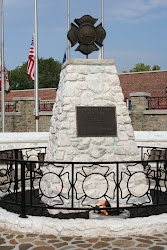
The National Fallen Firefighters Memorial. When our brother Joe died last year, one of the ways to remember him was to contribute to this small memorial in Emmittsburg, Maryland, just south of Gettysburg. As we made our way toward the battlefield, a sign told us of the memorial. It is on the grounds of the National Fire Training Academy (formerly the College of the Daughters of Charity) and the headquarters of FEMA, whom I'm sure you recall from Hurricane Katrina days. Because it is federal property, you need to sign in and wear visitor tags. But the memorial is lovely and touching in its simplicity and worth the visit. An eternal flame reminds us of how many of these men and women met their end. Plaques note the year and state they were from. One plaque by itself lists the names of the firefighters in NYC on 9/11. Nearby, a 20 foot sculpture depicts the famous picture of firemen raising the flag at Ground Zero.
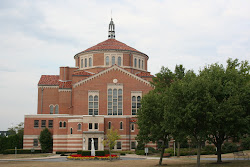
Right next door is the Shrine of St. Elizabeth Ann Seton, aka Mother Seton. Her shrine is an expansive basilica, decorated with mosaic and stained glass. A side altar allows a brief prayer to the saint, whose earthly remains are buried a few feet below the altar. The lower level is a testament to her life: her marriage and early widowhood; her conversion from the Episcopal Church; her founding of the Daughters/Sisters of Charity and its work in schools and healthcare.
Again, a beautiful and inspiring center of contemplation.
St. Meinrad's Abbey, Indiana. Most of us at some point have run into the catalog from "Abbey Press" with its quasi-religious posters or sayings and collectibles. As we drove along I-64, there was a sign for St. Meinrad, the town. Since we get the catalog, Patty recognized the name. It is an abbey of Benedictine Monks who work on two basic businesses: the books, posters et al; and caskets. They also have a beautiful church, built in 1904 and remodeled in the 1990s. We stumbled onto a tour being given by one of the monks, so that we were able to get a first-hand look at the church, the lower chapel (which evokes the Byzantine rite), and the garden, for which our tour guide was the primary caretaker.
The visits made us slightly late for our intended destinations, but I look forward to more traveling where time is not of the essence and we can folow the rules of serendipity as we will.

Trying to Understand the Civil War

The Civil War has been an integral part of our travels, even though that was not a primary objective. We began, of course, in Atlanta, whose burning by Sherman's troops was an important event in bringing the war to a close and "Gone With the Wind" to a climax. We spent some time in Montgomery, where the vote for Alabama to secede was held. We saw various signs for battlefields off the interstates. And then came two very different and geographically close sites: Harper's Ferry, West Virginia and Gettysburg, Pennsylvania.
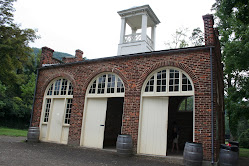
Harper's Ferry was the site of the attempted rebellion led by John Brown in 1859. Incensed by slavery, he attacked an armory there to try to get weapons for a slave rebellion. To some, he was a scoundrel - daring to attack the government itself, not knowing an even greater rebellion lay less than two years away. To others, he was a hero. When something is held to be morally wrong, some believe that you must do everything in your power to stop it; even violence. In 1861, after South Carolina, Virginia, and Alabama led the way to the formation of the Confederacy, Harper's Ferry was once again the scene of violence, with the armory and most of the town being laid to waste in bloody battles by the North and South.
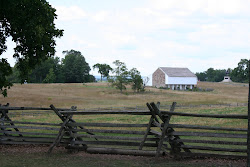
A study in contrast is Gettysburg, only about two hours to the north, just over the famed Mason-Dixon Line that separates Maryland from Pennsylvania. The town of Gettysburg was smack in the middle of the bloodiest battle of the war, yet only one citizen was killed by a stray bullet (Jennie Wade, for those trivia fans out there). The battle lasted three days, with luck and a few bad decisions (Pickett's Charge, for example), deciding victory for the North. Yet on July 4, 1863, so many dead bodies lay strewn around the farms that they were often buried on the spot they died. Later, local officials decided to bury them just outside their local cemetery (which had even been the site of a battle itself - Cemetery Ridge). Within 5 months, it had become a National Cemetery and was dedicated by the great orator of the day Edward Everett, and the president, Abraham Lincoln. Everett spoke for two hours; Lincoln for two minutes. Everett was hailed by the press; Lincoln was ridiculed for his "silly comments" (which, by the way, was not composed on the back of an envelope). Which do we remember? There's a lesson to be learned somewhere in there.
Thousands died in those three days - 5000 alone in Pickett's Charge. Some from as far away as Indiana, Texas, and the Nebraska territory. For something they believed in: states' rights or union. I'm not sure I could or would do the same.

Wednesday, August 13, 2008

Homogenized America

I occasionally have mixed emotions as I drive the highways and byways of the USA. No matter where you go, there may be a Walmart, or Home Depot, or Sears, Target, or J.C. Penney. There are Borders Books and Staples; "Mall West" here and "Mall East" there. There are, of course, McDonalds and Burger Kings, Wendy's, Cracker Barrels, and several Pizza Huts, even right here on the "country roads, West Virginia...." On the one hand, it's comforting. This is America. Even though we travels hundreds of miles from our home state, we are in the same land. Whether it's New Jersey or Missouri, we can count on the same products, the brand names we trust and purchase back home. While there are the occasional regional choices - Bass Pro Shops (for hunting/fishing/camping enthusiasts) as opposed to L.L. Bean; some restaurants differ slightly in their menus - there's no pulled pork like that of Memphis; you can't get biscuits and sausage gravy in too many places up north. But most of the time, if you drive just a little farther, you can find the store just like "back home".
On the other hand, it's also a little like listening to rap in Ireland. What has happened to our regional identities? Is there no more "South" or "West"? Just America? And is that a bad thing?

Monday, August 11, 2008

Go East, retired man

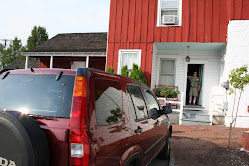
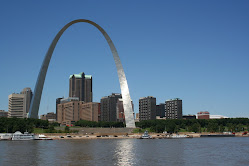
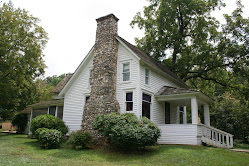
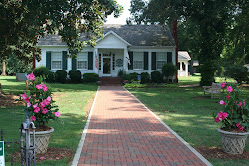
The circle is starting back, as we head east for the first time since Atlanta. It's somehow fitting that we do that by going backward through the Gateway of the West - St. Louis, Missouri. And even more fitting that we mark the occasion by ascending in the Gateway Arch (real name: Jefferson National Expansion Memorial) which we first observed (almost 32 years ago to the day) as we drove west on our honeymoon. The Arch is 630 feet above the Mississippi River, built in 1965. You ascend in a small (about 5' high) tram car that takes 4 minutes to reach the top where you can then look 50 miles east and west. A brief side trip before St. Louis had continued our literary tour, this time to the home of Laura Ingalls Wilder, known for the "Little House" book series, who lived most of her 90 years in this house. The visit gave a new appreciation for the books, and introduced me to her daughter - Rose Wilder Lane - who was also quite the writer. Her "most famous novel" was "When the Hurricane Blows" aka "The Young Pioneers". She was a news correspondent right up to the Vietnam War before her death in 1968.
PS: IF YOU WANT TO READ THE BEGINNING OF THE TRIP POSTS, SCROLL DOWN AND SELECT "OLD POSTS". THE PICTURES ALL STAY IN ORDER, BUT THE POSTS DON'T.